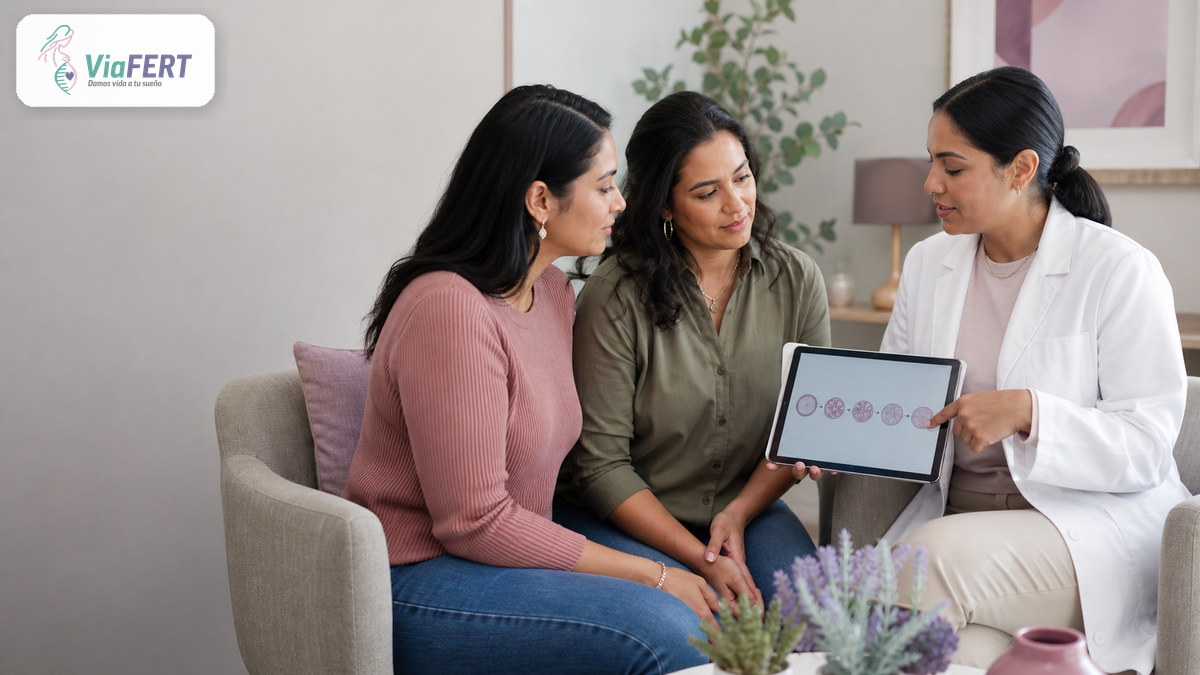
ROPA METHOD
The ROPA Method, which stands for Reception of Oocytes from the Partner, is designed for a couple of two women who both want to actively participate in Assisted Reproduction treatment, specifically in In Vitro Fertilization (IVF).
One of the partners in the ROPA method donates the eggs. Ovarian stimulation is tailored to the assessment and response of the partner providing the eggs. The clinical team individualizes medication, duration and monitoring; there is no single schedule for every couple. Source: ESHRE, ovarian stimulation (2025). Ultrasound monitoring tracks follicular growth (each follicle contains an egg), and once the eggs are mature, a follicular aspiration is performed. The eggs are then fertilized in our assisted reproduction laboratory using a previously selected sperm sample, either from a donor or a sperm bank (domestic or international). The embryos are cultured for a period of 5 to 7 days. PGT may be considered for a defined genetic question: PGT-A assesses chromosome number, PGT-M a specific familial variant, and PGT-SR imbalances associated with structural rearrangements. It is not automatically indicated for every couple; benefits, limitations and alternatives must be discussed, and it cannot guarantee an embryo free of every condition. Sources: ASRM, PGT-M (2023) and ASRM, PGT-A (2024).
The other partner in the ROPA method receives the embryo and carries the pregnancy. Endometrial preparation, medication and monitoring are tailored to the individual assessment. Transfer timing and the number of embryos are decided with the specialist, considering prognosis and prioritizing single-embryo transfer to reduce the risk of multiple pregnancy. Having two embryos available does not mean that both should be transferred. Source: ESHRE, number of embryos to transfer (2023 guideline; 2024 summary).
In the ROPA method, one partner may provide the eggs and the other may carry the pregnancy after individual assessment. Care at ViaFERT is coordinated with informed consent and a plan tailored to the reproductive role and medical needs of each partner; the method does not guarantee pregnancy or live birth.